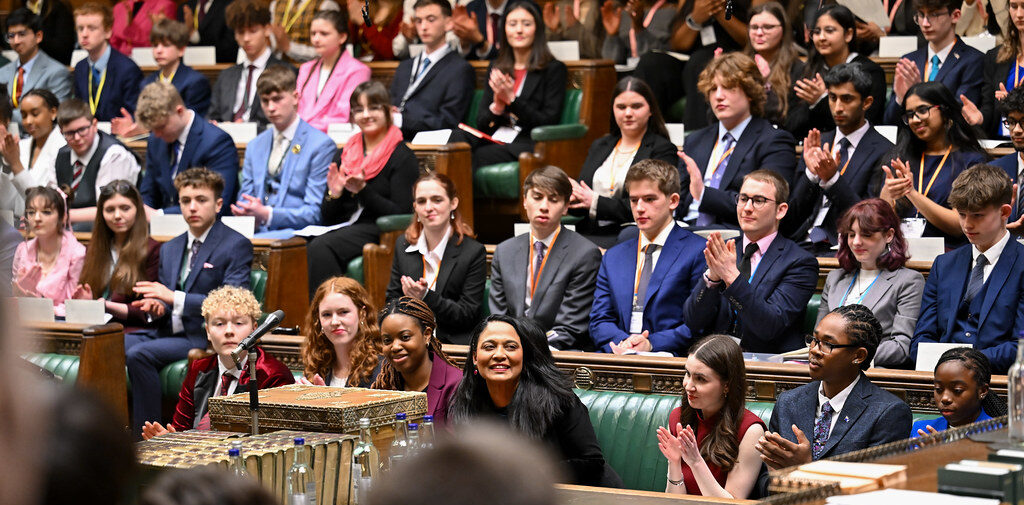
Image: House of Commons
How can the UK use the Youth, Peace and Security agenda as a vehicle to address the violence and insecurity faced by young people in Britain?
The celebration of the 10th anniversary of the Youth, Peace and Security (YPS in the United Nations this week provides a timely occasion to consider how and why the UK has largely ignored this agenda. There are a few possible entry points for thinking about YPS in the UK, but this piece focuses on one in particular: how YPS can be used to champion youth-led approaches to the violence and insecurity affecting young people in Britain today. In other words, how might we localise YPS for the UK context?
The few times that the UK has engaged with YPS in the past, it has almost exclusively done so through a foreign policy and international development lens, treating it as an agenda relevant only to conflict-affected countries. This is not unusual. Global North states often assume that thematic peace and security agendas are tools for countries and regions experiencing political instability or violence, overlooking their relevance at home.
In reality, young people in the UK are facing threats to their peace and security in increasingly complex ways. Rising hate crimes, youth homelessness, discriminatory policing, online harms, social fragmentation, and shrinking social infrastructure have created an environment in which many young people feel both insecure and unheard. At the same time, they remain largely excluded from decisions that shape their lives and the safety of their communities. As such, the assumption that the UK’s classification as a “peaceful” country exempts it from the work of ensuring peace and security for its young people is both inaccurate and unhelpful.
Localising YPS in the UK therefore requires a dual recognition: first, that the everyday challenges young people face constitute real peace and security issues; and second, that young people must be meaningfully included in addressing them. This piece focuses on the domestic importance of YPS in, not because I do not think its important for the UK to be a leader on YPS internationally, but because I think a) some of the arguments for the foreign policy implementation are more intuitive b) assuming British society is entirely peaceful obscures the urgency of applying YPS at home and c) leaders in the UK must first be accountable to young people in Britain before claiming expertise on YPS abroad.
In the following, I outline why young people in the UK need the YPS agenda, examine how current approaches often misframe youth as security threats rather than partners, and explore why the UK has yet to meaningfully engage with YPS domestically. I then draw on Finland’s National Action Plan as a model for how a ‘peaceful’ country can adapt YPS to address internal forms of insecurity, before considering what a youth-inclusive, peace-oriented approach could look like in the UK context.
Why do young people in the UK need YPS?
It only takes a cursor glance at the news in the UK at the moment to see that young people in the UK feel concern about the direction the country is going in, worried about their futures, forgotten by major political parties and unable to contribute to changing these realities. In fact, a recent Next Generation UK study carried out by the British Council found that young people feel an overriding lack of security in various areas of life, ranging from the cost of living and financial opportunity, a decline in services and social provisions, trust in the political system to geopolitical threats. One take-away from this study is that while youth feel they hold personal freedom and empowerment, they are collectively disempowered and pessimistic about the future of their communities and society as a whole. However, the young people who contributed to the study do not feel apathetic about their lives and contributing to societal improvement. They just think that better cooperation and support is needed to achieve this.
There are various factors that explain these feelings of insecurity amongst youth in the UK: a steady rise in young people not in education, employment or training; a rise in hate crimes based on race, sexual orientation and gender identity, religion and disability including in educational settings; increased hostility towards refugees and migrants, which has an adverse affect on young people given that half of new arrivals to the UK since 2011 were under 25s; youth exploitation and involvement in gangs, extremist networks or other predatory groups and; a troubling rise in the amount of unhoused young people, with an increase of 74% since 2010. These factors have been worsened by the decline in third spaces, such as youth clubs and community groups, and the fast-tracked and largely unregulated growth of social media and online spaces in which young people have taken a front seat.
The reasons for these overlapping crises are multi-fold but what is important here is that we recognise that these crises constitute a threat to peaceful and secure livelihoods. When we allow ourselves to frame the situation in this way the YPS agenda becomes a useful, and currently overlooked, tool to address the issues confronting youth in the UK in a way that gives them power and agency. The agenda makes explicit the need to work with young people to overcome forms of insecurity that can both inhibit young people and make them more vulnerable to violence, and this is true whether in
Avoiding the securitisation of youth
This framing of youth, and the issues they face, as a security question is already happening in the UK. However, the current framing is not conducive to helping young people overcome barriers to full inclusion in social, political and economic life. Instead, we see the stereotyping of young people as disrupters of peace and instigators of violence. This stereotype has long existed in the UK and manifests along gendered, racialized and class-based lines. More recently, it has developed into the securitisation of young people – with young men and those of ethnic minorities a particular target – whose behavior is often labelled as dangerous and a threat to ‘British values’ and community cohesion. Youth are increasingly faced with rising youth-focused policing, and expanding surveillance measures that treat their behaviours as potential security threats rather than social issues. For example the UK’s Prevent strategy on counter-terrorism has recently been criticised by Amnesty International on human rights grounds. In particular, they warn of the concerning over-representation of children and young people in Prevent referrals, cite specific stereotypes as the reason for this and call for better efforts to overcome wider disillusionment as a more effective way of dealing with radicalisation.
This problematic stereotype has been universally recognised as detrimental to the success and inclusion of young people and countering it has been one of the top priorities of the YPS agenda. Much of the early (and still ongoing) discussion around the agenda by youth advocates and within the UN focused on seeing youth as ‘peacemakers’ rather than ‘troublemakers’ as key to advancing their participation in peace and security. The first resolution on YPS (UNSCR 2250) affirms the need to see youth as positive contributors to peace while the first Independent Progress Study on YPS (2018) specifically warns of a growing mistrust between young people and governments, policymakers and international organisations which is driven by a pervasive stereotypes of young men as ‘violent predators’ and young women as ‘passive victims’. This recognition positions YPS as an effective framework for addressing for youth insecurity. Instead of the binary and stereotyping approach taken by schemes like Prevent, a YPS-based approach would encourage the government and other authority bodies to work with young people to understand how best to prevent violence and provide them more security.
Domestic application: Lessons from WPS
The insecurity and violence experienced, and unfortunately sometimes perpetrated, by young people in the UK does not necessarily present in the ways that align with international peace and security frameworks. This has led to leaders in the UK overlooking the relevance of global agendas like YPS in the domestic context by assuming that according to international standards, the UK is a ‘peaceful’ country. This has only been to our detriment. Things are starting to change with the Women, Peace and Security (WPS) agenda, which the UK has been a leader on globally for a long time. The most recent UK National Action Plan on WPS (2023-2027) has for the first time an explicit focus on the domestic implementation of the agenda, with specific attention to violence against women and girls (VAWG), and championing UK expertise, for example female peacebuilders from Northern Ireland. This is evidence of the government’s recognition that peace and security framing is applicable in countries that do not see active conflict and in fact might be useful for confronting domestic challenges. This suggests clearly that there might be both appetite and capacity to do something similar with YPS.
Learning from others: domestic framing of YPS in Finland’s National Action Plan
How then might a country not experiencing conflict within its borders use the YPS to combat insecurity for young people within its borders? Here, Finland offers a model for the UK as a country with similar peace and security standings. Finland was one of the first countries to develop a NAP on YPS*. It is also the only country in the Global North to have developed a YPS NAP and explicitly recognised in the NAP that ‘although [they are] not a country in conflict, it is necessary to work in Finland to promote peacebuilding and prevent conflicts. Security and conflict prevention must be seen as broad concepts that underpin social stability, citizens’ wellbeing and measures to strengthen inclusion’ (p9). In recognising this need to see peace and security in a less narrow manner, the NAP goes on to list some key challenges affecting young people in Finland that fall under this banner: terrorism and violent extremism, spread of disinformation and hate speech, peer violence, discrimination and mental health, climate change and migration. These challenges mirror those experienced by youth in the UK.
Finland’s NAP offers some suggestions for domestic implementation that focuses on youth inclusive processes that target specific areas of insecurity. These include: improving out-reach to young people not currently involved in formal youth groups or organisations; bringing young people onboard as co-designers and co-implementers within P/CVE programmes; framing youth as stakeholders in programmes on unemployment, retention in education and social inclusion; ensuring inclusive participation by minority, migrant, and refugee youth organisations on policies that affect their status and supporting the participation of young people in the planning and implementation of reintegration measures those who have experienced radicalisation, time in prison or conflict. Here, we see a clear guide for how broader peace and security measures, many of which are already in action in the UK, can be adapted to become youth-inclusive and youth-led. Having an NAP has allowed Finland to be explicit in tackling insecurity for its young people with its young people.
So, what would this look like in the UK?
The UK could employ these same approaches to better involve youth in overcoming the insecurity that they face. Doing so would first require a meaningful recognition that young people have a) the motivation to collectively tackle the challenges they face and b) the ideas about how to do this but that they need to be provided with financial support and policy space to enact these ideas.
One example of a peace and security initiative already involving young people from the UK is the Youth Network for Peace (YNP), an EU funded project that ran from 2017-2021 across Northern Ireland and the Republic of Ireland. YNP was youth-led and focused on building cross-community and cross-border projects for ‘meaningful, purposeful & sustained contact between young people from different communities’. It ensured equal inclusion from people and community divides e.g. Protestant-Catholic; rural-urban; male-female. The program was seen as particularly important because it addressed the issue of low youth participation that might otherwise have led to disenfranchisement and a reinforcing of insular community thinking across generations. In communities that work so hard to maintain peace in a complex post-conflict environment, it is clear that the importance of youth involvement to this commitment was recognised. In fact, the rest of the UK could learn a lot from how inter-community peace is managed in the Irish context, and this includes youth inclusion and participation. In the post-Brexit era, the UK Government needs to take the onus on funding these kinds of projects across the country. Commitment to YPS will provide an avenue and accountability mechanism in which to do this.
The UK could implement similar programmes that bring together young people tackling racism, islamophobia and antisemitism, giving them the resources to on these issues both within and across their communities. Providing this agency will also prevent this discrimination leading to disillusionment. This is something being developed by organisations like Future Leaders UK that with more support could reach more communities. From the prevention side of things, learning from Finland and their support for young people’s participation in planning and implementation of anti-radicalisation. This will help tackle P/CVE in an youth-inclusive way rather than through hard security strategies that are imposed upon young people. This might take the form of a youth anti-radicalisation advisory board.
A YPS framework might also be used to think about how we welcome and integrate young migrants and refugees, many of which have experienced conflict, in ways that increase their security and chances of success in Britain. Allowing those that experience this transition have an input on how best to support new arrivals will lead to better outcomes for these young people. This should be accompanied by youth-led initiatives to bridge the growing hostility experienced by refugees and migrants. Empowering young people to be leaders in changing harmful narratives around migration and building compassionate communities will be a benefit to the security of all generations.
It could also be employed in tackling online safety, the rise in VAWG and misogynistic ‘incel’ cultures, an issue that has recently been discussed at a high-level across the UK following the Netflix series ‘Adolescence’. Youth-led initiatives are uniquely positioned to address online harm and related violence against young women because young people possess first-hand knowledge of digital environments, the social dynamics that foster harassment, and the ways dangerous attitudes and misogyny propagate online. Listening and including young people’s ideas for overcoming this type of insecurity is vital to the success of any policy.
Conclusion
It is time for the UK to take including youth in overcoming their own insecurity seriously. The challenges young people face are real peace and security issues that cannot be addressed without their input. The UK’s current tendency to securitise youth, rather than empower them, stands in stark contrast to the core principles of YPS. By adopting a YPS-informed approach, the UK could provide structure, accountability and support for the youth initiatives that already exist across the country. Drawing on Finland’s example, this piece has demonstrated that a country need not be experiencing armed conflict to meaningfully apply the agenda. Youth-led participation in prevention, inclusion, integration and community safety is both possible and effective when it is built into policy from the outset. Doing so would not only ensure that young people have a say in shaping their own safety and wellbeing, but would also position the UK as a credible and committed actor within the broader YPS agenda moving forward.
—————–
* Since this article was written, Finland has published its second NAP on YPS (2025-2028) to coincide with the December 2025 10th anniversary of the YPS agenda. While this article was informed by the previous NAP, a first reading of the new document shows that the key aims and actions remain the same. Together they provide a useful tool from which the UK Government can think about YPS in the domestic context.
About the Author
Imogen Fraser is a young researcher and Youth, Peace and Security advocate. She currently works as a research assistant for the Research Network for Women, Peace and Security (Canada) and as the network Coordinator at the Canadian Coalition for Youth, Peace and Security. She has a BA in International Relations from the School of Oriental and African Studies (SOAS), University of London and an MA in Political Science from McGill University in Canada. Imogen is interested in various forms of youth advocacy and peacebuilding, with a particular focus on disarmament post-conflict reconciliation. She is also passionate about the power of informal and extra-curricular education and using sport as a tool for peace. Find out more about her work here.