Earlier this month, I was travelling down to London. There were a few items on the agenda: an interview lined up during the week, a crisis simulation hosted by RUSI, and enjoying time spent with friends paired with cold drinks and warm weather. While the latter held most of my attention, RUSI’s crisis simulation was an event I had been looking forward to since I had signed up some weeks prior. The mention of the word ‘resilience’ was enough to pique my interest given BIGA’s podcast on that very theme. Yet, I was to be met with crisis well before this simulation took place.
First Response
As I was heading into my town’s centre early to get lunch before my train, I double-checked my tickets to know exactly when I needed to reach the station. Blaring in bright red letters was an announcement that my train had been cancelled. While frustrating, it hardly constituted a crisis. I managed to grab a quick bite to eat before getting the earlier train down. Because I hadn’t booked onto this particular train, I wandered down the carriage aisles looking for a free seat. Eventually, upon arriving at a cabin with broken AC, I found a seat at a table with a man who seemed to have a conviction against using deodorant, another suffering bystander, and a nun.
Around halfway through our stifling journey, the nun began to look increasingly frustrated with the heat and got up to find fresh air. As she moved toward the carriage ahead, I saw her collapse and be caught by a passerby. I left my seat and went to support her. As a teenager, I had done hours of First Aid training in Scouts but it nonetheless felt surreal to actually need to apply my adolescent teachings. One of the first things you are taught is to take control of the situation: those without training are likely to panic and get in the way. Stress was beginning to clearly show on the face of the bewildered man who had caught our half-conscious nun and nearby passengers who had also seen the incident were reaching the intersection in a worry. I told one of them to get water and another to find staff to alert them.
Besides checking for further danger (thankfully nothing was apparent in this situation), the immediate checklist for First Aid is ABC: Airways, Breathing, Circulation – is there anything stopping them from breathing? If not, are they breathing? Can you feel a pulse? The nun was conscious though saying she felt like she was going to be sick so this checklist had already been resolved. When she proceeded to vomit, the fellow passengers began to look on in increasing panic but there was nothing to suggest it was anything besides heat (an assumption that would be vindicated but one that I should not have made). By this point, overhead voice comms had requested medical support in our carriage and I could see determined passengers who could only be medical practitioners heading in our direction. I told the non-medical passengers to clear the area and get more water.
A GP arrived and I supported her by fanning the nun who was now on the road to recovery. The GP asked a few questions I hadn’t thought to bring up: did our patient have any chest pain? Did she have any pre-existing medical conditions or allergies? The nun replied in the negative, affirming it was just the heat but it was a reminder to not take a situation at face value. She also removed a small veil around the nun’s neck that I hadn’t considered might be an obstruction – another reminder to shape the situation as needed rather than simply react to it. We spent the rest of the train journey supporting her and finding her a cooler carriage before getting her and her luggage to staff waiting for us at Euston.
First Reaction
This journey wasn’t what I had expected it to be but besides being glad that my Scouting skills had been of some modest utility, the incident had provided food for thought. Beyond making assumptions that could have led to a deterioration in the nun’s condition, I had also not thought to remove the veil/bib around her neck. I had managed the environment well in keeping others calm and giving instructions but there were two key lessons that struck me. The first was how rusty our preparations can become when left unused. The second was about adapting those skills to new environments: my Scout training on First Aid had focused on likely scenarios when out hiking in the wilderness (a helpful education given the context) but this was of limited utility to an urban environment with its own likely challenges in our sultry age. It was an unexpected lesson in reacting to crises but it was not to be the last.
Backwards Briefing Rooms
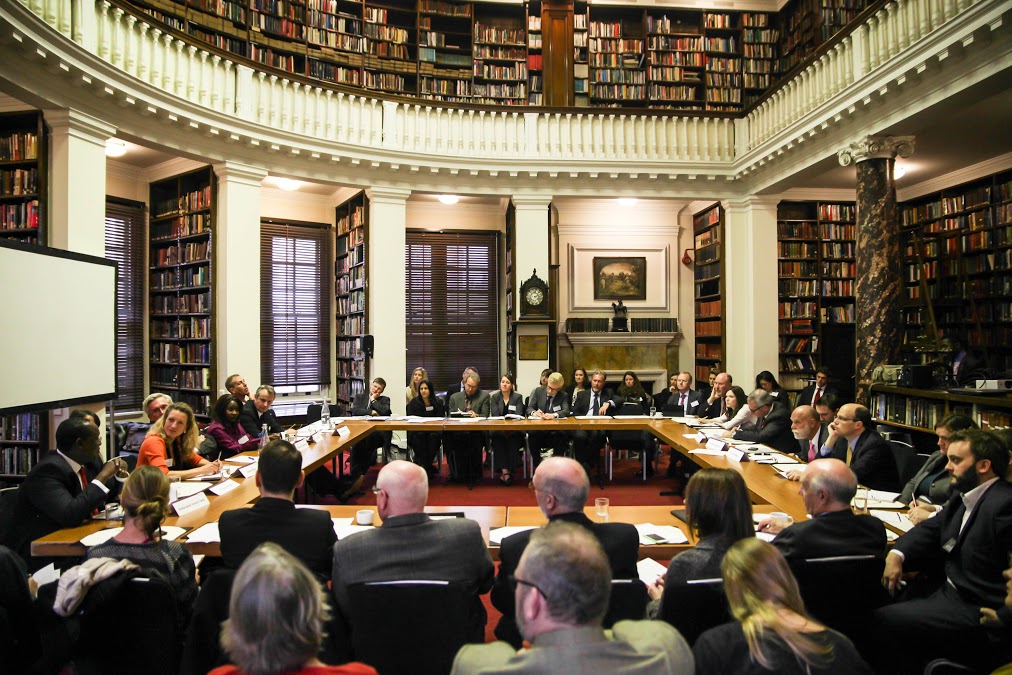
My week in London proceeded with all the expected delights and none of the unexpected surprises that the train journey had portended. Scheduled on my last full day in London was the crisis simulation hosted by RUSI. I wandered through Horse Guards Avenue and was accepted into the RUSI building. Climbing the stairs past paintings of triumph and busts of victors, I arrived at a semi-circular library filled with journals, memoirs, and fellow participants waiting for the session to begin.
The simulation was led by RBOC – Resilience Beyond Observable Capabilities (a reverse of the famous COBR, as our instructor explained) – an organisation led by professors and others to stimulate crises and develop resilience preparations. The thirty of us were divided into different groups, each allocated a different responsibility. One table represented the fire department, another the police, while we represented Greater Manchester Combined Authority. The situation was set out: the year was 2051 and Britain had gone electric. The month was January and the weather was harsh. While we had arrived at RUSI at 3pm, the time inside the simulation was 8:15am but besides that, we were operating in real time (20 minutes was 20 minutes inside and outside of the simulation).
We had three incidents, each separate but compounding on the last. The first incident began at 8:15am – GMCA’s IT had been hacked and was being held ransom – and we were given 20 minutes to decide how we would proceed based on the options provided or our own decision. As each decision was reached, we also had to write down our justification. An hour later and we had reached our fourth intersection: briefing the Mayor ahead of a press conference.
As each update arrived, it was easy to feel a sense of panic. There were so many angles to look at and so many factors to take into consideration that the potential to be overwhelmed by events was made apparent. For those who remember their GCSE or A-Level exams, the feeling is the same: opening the exam book to face a question of limitless possibilities. What I realised by the end of the first incident was the necessity of setting out clear priorities – something easier realised in description than in activity. Even jotting down three or four clear goals set priorities to help manage further incidents, much like jotting down three key points for answering an essay.
Within these simulations, you learn a lot about yourself as well as those around you. I have an instinctive leaning towards finding a “good enough” solution wherein getting the ball rolling is more important than finding the most optimal solution. One of my teammates, however, was critical and thoughtful in a way that was initially frustrating but revealed itself to hold weight. Her expertise mattered and in the rush to find a solution, I hadn’t thought about how best to allocate time. By the time I had clarified my instinct toward a specific decision, there was still remaining time to discuss the situation further and justify our decision well. Action is important, but managing one’s time appropriately to thoroughly consider the options available is too. What was less helpful was our other two teammates spending the final minutes of each incident raising non-critical considerations and wasting valuable time fretting about every ramification. At one point, one of them had said “to be honest, I wouldn’t know what to do here at all”. Uncertainty is inherent in a crisis, but choosing to remain uncertain with one’s course of action leaves everyone unsure as to what happens next.
There were no right answers in the simulation but there were wrong ones. As the activity came to a close, we had a chance to reflect with the instructors on the different aspects that shaped our interaction. Much of my thoughts as to what was needed to navigate a crisis reflected the incident on the train as much as the various incidents affecting Manchester’s future.
Final Reflections
Perhaps the most important takeaway from the crisis simulation was the need for priorities. Crises, by their very nature, startle the established flow of activity and make a seemingly-predictable future suddenly very unpredictable. In such a moment, nothing can be assumed and everything benefits from scrutiny but the vital resource of time is finite and often dwindling. Priorities provide direction and instigate not only a response to circumstances but also pro-activity in controlling events – something the instructor noted at the end of the session. First Aid essentially works off the same basis: Check for Further Danger -> Airways, Breathing, Circulation (ABC) sets out an immediate and memorable checklist of critical priorities regardless of circumstance.
Moving past priorities, two of the most important qualities a person can hope to have in a moment of crisis are cool-headedness and expertise. The former preserves order when it is failing and creates it when it is lacking. The latter facilitates thoughtful policy and actions that can remedy the situation better than would otherwise be hoped for. That is as true for a former Scout and a GP dealing with a patient suffering from the heat as it is for political decisionmakers responding to a myriad of aleatory and malicious issues.
Finally, an unexpected aspect present in the crisis simulation that was not apparent on the train was rapport. While the latter was a situation with little room to really know the interlocutors involved, the former offered participants the chance to chat and mingle before the activity began. As other tables sat together awkwardly, I had decided to rope my teammates into conversation discussing university degrees, their time in London, what brought them to the event and other such banalities that still provide insight into the experiences and quirks of the people you may rely on. Such rapport allowed me to be more encouraging of discussion and ideas when time allowed and more firm when it did not. With even this small rapport, we avoided the risks of being too mild or creating too much friction in the pursuit of decision.
Earlier this year, Paris hosted the G7 Summit and centered discussions around the concept of the ‘polycrisis’. Polycrisis is a recent term referring to a situation where a government does not simply handle multiple crises one after the other such as COVID-19 and Russia’s invasion of Ukraine, but rather multiple crises at the same time. There is a sense that this is the world we are moving into: one more fragile and volatile where we should hope to be so lucky as to only encounter one crisis at a time. For resilience to work, we ultimately need exposure. Simulations, preparation, and a risk-tolerant willingness to confront challenges that develop our capacity for handling pressure are all needed to tackle the crises to come. Empathy and conviction, analysis and intuition; there is no blueprint for knowing what to hold aloft as the ideal but through practice we can nurture our ability to judge what is required to survive and thrive in uncertainty.