Author’s Note: This piece was written as part of BIGA’s new partnership with EPIS, a student-led think tank in Europe who support discussion and debate from a variety of disciplines and backgrounds. Be sure to check out their work!
During a spring day in Washington D.C., in April 1949, the North Atlantic Treaty was signed. NATO had been created. Its first General-Secretary was Lord Hastings Ismay, a child of the British Empire who had been born in India, trained at the Royal Military College in Sandhurst, fought in Somalia during World War I and then went on to serve Prime Minister Winston Churchill as his chief military assistant. Lord Ismay is a largely-forgotten figure to the public memory but is more commonly known for his laconic statement of NATO’s purpose: to keep the Russians out, the Americans in, and the Germans down (Mcdonald, 2022).
NATO was signed into existence in Washington D.C., but it was a distinctly British strategic triumph. The United Kingdom stood victor over the Third Reich. It had secured a Permanent seat on the newly-formed United Nations Security Council (with the associated veto privileges), and now enjoyed a significant position in a military alliance bridging its European allies with its American friends (Stoltenberg, 2025). If one were to look at what British foreign policy had been before the outbreak of World War II, or even preceding World War I, it would have been thus: 1) prevent a continental European hegemon (Kissinger, 2014); 2) deny Russia its expansionist goals when it threatened the Empire’s overseas holdings or European stability (Frankopan, 2016) and; 3) cultivate shared interests with the US to ensure its support for protecting free maritime trade and challenging disruptive powers (Gaddis, 2018). Following Britain’s success in the Second World War and the subsequent creation of NATO, all three had been comprehensively achieved. While echoes of this strategy are still heard today, Britain has become complacent from its success. It is therefore worth considering where this strategy came from, and what can be done with it today.
Eyes on the Horizon
The Tudor period is popularly known for its dramatic blend of romantic chivalry and oppressive misogyny providing endless source material for TV entertainment. For England, and indeed Britain, however, it would prove to be utterly transformative. At the start of the Tudor age, in 1485, England found itself as the bankrupt, war-torn, rainy, wool-exporting neighbour of continental Europe. Nonetheless, its distinct Catholic identity, ownership of Calais, and long-standing claim to the French crown would mean that it was still definitively European in nature. The start of Henry VIII’s reign would reaffirm this: Pope Clement VII would recognise him as fidei defensor (Defender of the Faith), a title that remains a feature on British coins to this day. Yet this dynastically insecure king chose to break from the Pope’s authority and claim full sovereignty over England’s political authority in order to divorce his then-infertile wife and ensure the continuation of his lineage (Guy, 1988).
Over the decades that followed, England would lose Calais and become a distinct island both culturally and physically. Almost immediately, the prospect of what that meant was raised when it seemed as though the King of France and the Holy Roman Emperor would unite to oust the Protestant upstart. While the plotting fell through on this occasion – providing more material for TV drama in the form of Anne of Cleves – the very real threat of a united Europe set against England was made manifest.
Under Elizabeth, the beginnings of contemporary England/Britain would further emerge. To match the Spanish Empire’s ascendancy, England’s sailors were granted licenses to plunder Spanish treasure ships while Royal Charters were issued to pioneering traders wishing to set up trade monopolies in far-off lands – in 1600, Elizabeth I signed the East India Company into life. While the Spanish would then raise the “Invincible Armada” in an attempt to invade England and ultimately fail, the threat of a European hegemon to England’s position was nevertheless made disconcertingly clear (Gaddis, 2018). For a new generation of policymakers, the Tudor era had demonstrated that England could keep apace with its continental counterparts when it engaged with the New World but it nonetheless needed to find some way of thwarting an overly-dominant power or alliance from threatening the home islands.
The Sun That Never Set
The formation of Britain and its empire was relentless, albeit spasmodic, and far-reaching. Much can be said about what contemporary Britain has inherited from this period but suffice to say that the fledgling United Kingdom developed a keen desire to balance the powers of Europe, generate coalitions, and prevent a dominant hegemon that could threaten invasion or isolation as the Spanish had. For centuries, this meant opposing France – whether led by Louis XIV or Napoleon – though it would later result in allying with France to undermine Russia in the Crimean War and then the newly-formed Germany in both World Wars (Kissinger, 2014).
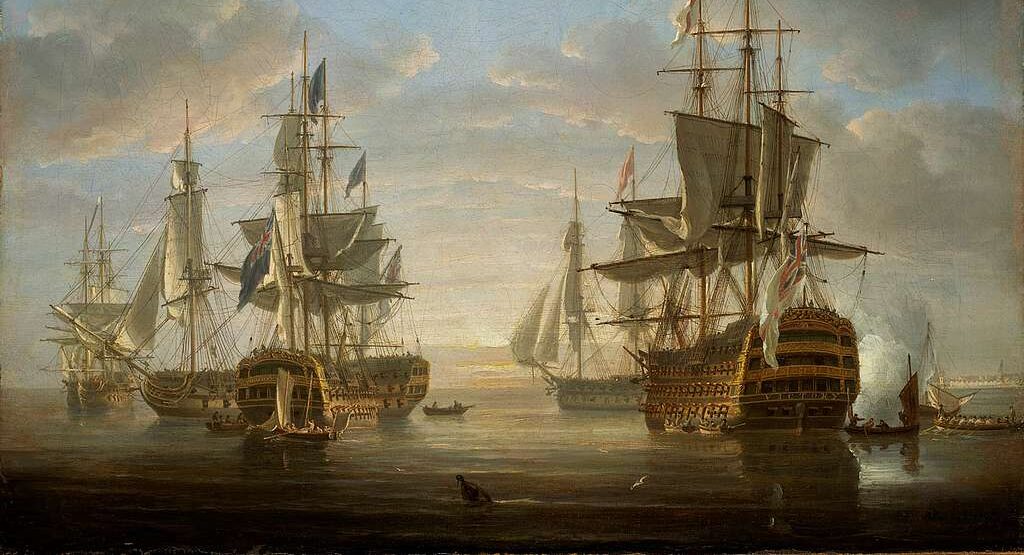
To sustain its stand against European hegemons, Britain would increasingly connect with the wider world and secure imperial trade that catapulted itself into the world’s leading economic power. Whether it was the international connections and trade, the safety from land-based powers, or the ability to outlast opponents from Revolutionary France to Nazi Germany in protracted wars, all was made possible by the Royal Navy (Richards and Lindley-French, 2024).
The loss of the 13 colonies that would become the United States of America did little to hamper the growth of the British Empire. In the late 19th century, it dominated the world stage before reaching its geographical zenith after the First World War. What the American War of Independence did achieve, however, was the creation of an independent state that would later span a continent, have access to two oceans, and be constituted on English legal principles. Despite its rejection of British authority, there was an economic powerhouse that shared many of the same values as Britain – free-trade, liberty, and pluralism – as well as many of the same interests. Britain’s acceptance of the Monroe Doctrine and neutrality in the American Civil War set the stage for having an ally that could provide the financing, food, and potential military support in any conflict that proved too vicious for the United Kingdom to handle (Gaddis, 2018).
Britain’s strategy was to prevent isolation and invasion by balancing the Continental powers; connecting with the wider world to gain sustenance and economic growth; and cultivating a relationship with America that ensured its support for the big challenges. This strategy was so successful that not only did it sustain an empire for around four centuries, but the United Kingdom was also the only Western European power to come out of World War II with a memory of victory. Italy had killed their leader; Germany was carved up by the remaining powers; and the French state suffered defeat, even if its people maintained their resistance (Cooper, 2021; O’Brien, 2024). When the war came to a close and NATO was formed in 1949, the United Kingdom felt no need to change its fundamental strategy and declined to join the European Coal and Steel Community negotiations in 1950 out of concern for participating in a supranational organisation (as opposed to an international organisation) (Gabel, 2026).
Circling Back, Looking Forward
In the 80 years since World War II, the United Kingdom’s position has been largely secure. It has reaped the rewards of generations of strategic practice as well as having the conviction that it had both the right and the ability to take action in the world. Today, however, the structures built to house a secure Britain have been crumbling. When Britain turned away from Europe’s economic union in 1950, it was an empire, still able to generate its own capabilities to influence events. It leveraged this position to balance Europe, generate coalitions, engage the United States, and profit from open trade in the broader world. In the present day, British leadership finds itself hampered by unresolved difficulties at home bred from a changing global economy (Bell, 2025). All the while, Britain has become stuck between an increasingly domineering and erratic United States and a European Union that 52% of its electorate blamed for its domestic woes.
When it comes to British leaders, all face the daunting prospect of working under the shadow cast by Winston Churchill. In 1948, Churchill set out a vision for British foreign policy based on three ‘Majestic Circles’ that attempted to draw together the broader Commonwealth; the Anglophone countries that now comprise the Five Eyes intelligence alliance; and a “United Europe” (Davis, 2015). His was a distinctly imperialist ambition, but it still remains relevant today. For the United Kingdom to get its strategic positioning right, it must create productive international connections beyond the Western world; a special, but not subordinate, relationship with the United States; and close ties to Europe. The difference, however, between strategic positioning and desperate oscillation is down to whether the United Kingdom is willing to do what it takes domestically to generate power rather than just project it (Richards and Lindley-French, 2024; O’Brien, 2025).
Bibliography
- Bell, T., 2025. Great Britain?: How We Get Our Future Back. United Kingdom: Vintage Penguin House.
- Cooper, R., 2021. The Ambassadors: Thinking about Diplomacy from Machiavelli to Modern Times. United Kingdom: Weidenfeld and Nicolson.
- Davis, R., 2015. WSC’s “Three Majestic Circles” [Online]. United Kingdom: International Churchill Society. Available From: https://winstonchurchill.org/publications/finest-hour/finest-hour-160/articles-wsc-s-three-majestic-circles/ [Accessed 6th March 2026].
- Frankopan. P., 2016. The Silk Roads: A New History of the World. London: Bloomsbury
- Gabel, M., 2026. European Union [Online]. United Kingdom: Britannica. Available From: https://www.britannica.com/topic/European-Union/The-euro-zone-debt-crisis [Accessed 6th March 2026].
- Gaddis, J. L., 2018. On Grand Strategy. United Kingdom: Allen Lane.
- Guy, T., 1988. Tudor England. Oxford: Oxford University Press.
- Kissinger, H., 2014. World Order: Reflections on the Character of Nations and the Course of History. United Kingdom: Penguin Books.
- McDonald, S., 2022. Leadership: Lessons from a Life in Diplomacy. London: Haus Publishing.
- O’Brien, P., 2024. The Strategists: How War Made Them and How They Made War. United Kingdom: Viking Penguin.
- O’Brien, P., 2025. War and Power: Who Wins Wars – and Why. United Kingdom: Viking Penguin.
- Stoltenberg, J., 2025. On My Watch: Leading NATO in a Time of War. London: William Collins.
- Richards, D., and Lindley-French, J., 2024. The Retreat from Strategy: Britain’s Dangerous Confusion of Interests with Values. London: Hurst & Company.