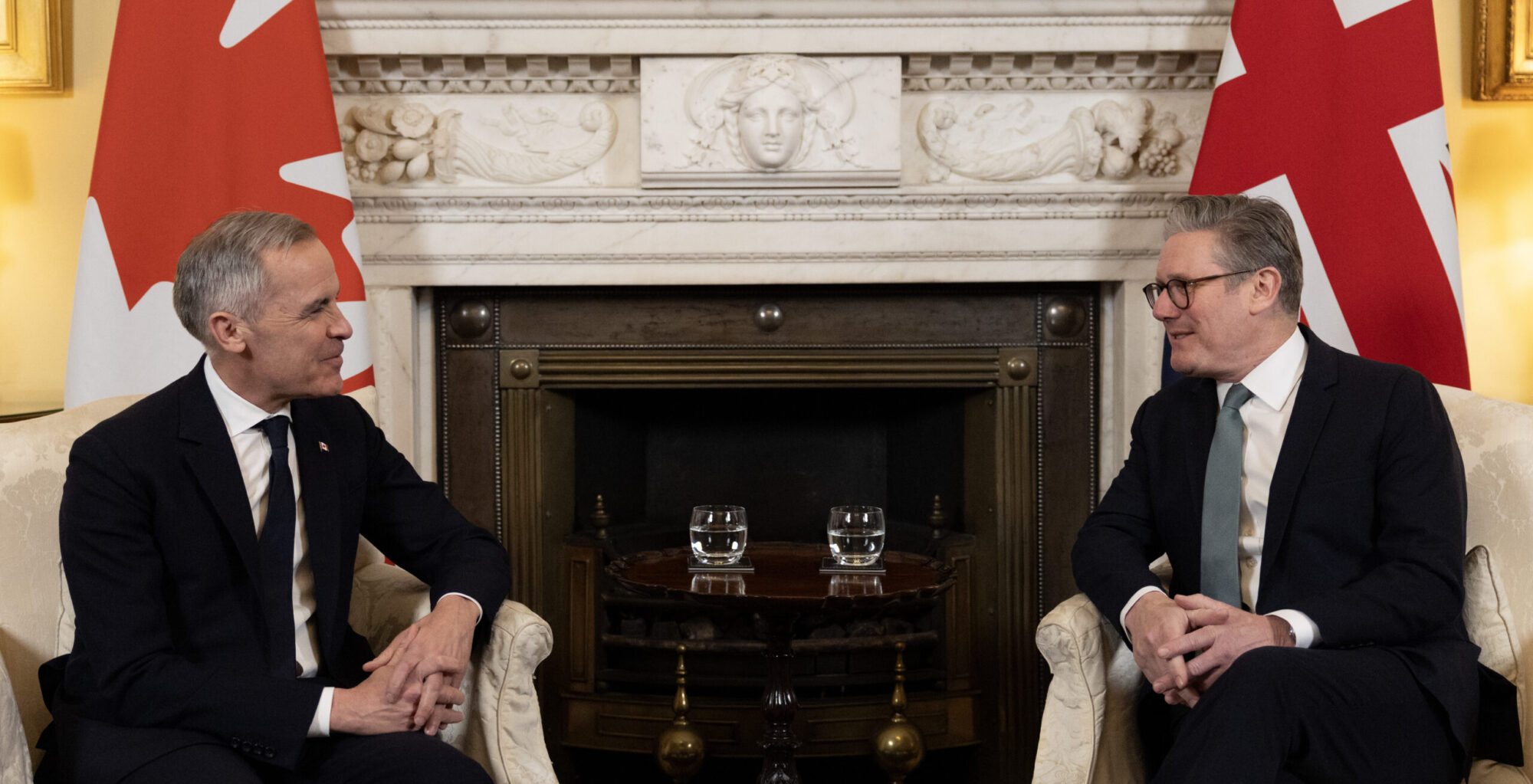
Photo: Lauren Hurley/No 10 Downing Street
The United Kingdom finds itself torn between its closest allies. Whether it’s an increasingly subsidiary and powerless role compared to the United States or the difficult political relationship with the European Union, the ability to exert influence in the diplomatic sphere is strained. If future American administrations perceive any economic rewards from Trumpian attitudes towards allies based on tariffs, belligerence towards allies rather than rivals and apathy towards international cooperation, the UK risks losing the ‘special relationship’ as a bedrock of its foreign policy. In a struggle to find ways around this new paradigm, the English-speaking world, especially Canada, Australia, New Zealand and the UK having previously held greater positions of diplomatic influence, now require new methods to exert themselves and protect any values held dear, (even sovereignty in Canada’s case).
Already bound in their pasts as imperial confidantes, the four aforementioned countries comprise what are called the ‘CANZUK’ countries. The proposal around this alliance is based around their shared values in every field from political, cultural, linguistic and historical similarities. All four states are members of ‘the Commonwealth’ which acts as a platform for diplomacy and dialogue mainly between those countries formerly under British imperial rule. However, whilst this is essential to the UKs global image, the Commonwealth has not protected its members from the shocks sown by new dynamics from the United States and China.
Four middle-powers lost without a sense of purpose can find solutions in CANZUK. Through the pooling of their labour markets, professional services, diplomacy and free exchange of peoples, Canada, Australia, New Zealand and the United Kingdom can reinvent themselves as new diplomatic powerhouses, capable of better negotiating and protecting their interests in Europe, North America and the Indo-Pacific. ‘CANZUK International,’ the leading NGO for this initiative, predicates the alliance on free trade, free movement and foreign policy cooperation. Free movement is most controversial for the UK, due to the negative connotations surrounding its usage in the European Union, creating the dissatisfaction that led to ‘Brexit.’ However, to reframe that goal around free trade and foreign policy cooperation with other CANZUK countries can better appeal to the population and politicians of the UK. The difference from free movement in the EU is that CANZUK is associated with cooperation between countries with identical cultural and political apparatus. However, EU free movement, (especially after the 2015 Migrant Crisis), became associated with negative political decisions against the UKs interests.
All member countries closely cooperate in the great challenges of today with Russia’s war on Ukraine and the rise of China as the second superpower. All impose heavy sanctions on Russia’s war machine from oil and gas to targeted sanctions against individuals directly and indirectly involved in Russia’s economy. With Russia’s history of poisonings against dissidents and spying, the UK can lead the creation of CANZUK to coordinate pressure on Russia for its crimes against the UK, Ukraine, other European countries and its CANZUK allies. Russia’s relationship with Australia is severely strained due to the alleged downing of Flight MH317 in 2014 which killed 298 people, (including 38 Australians). All CANZUK countries have also had to wrestle against spying and espionage tactics by the Chinese government against dissidents-in-exile in their countries. Therefore, CANZUK countries could benefit from a treaty which compels a coordinated response towards these two anti-western powers to counter the malign influence they try to exert.
The UK can stand to gain in multiple ways economically from CANZUK. Being the only nuclear power of the four, CANZUK can provide a secure supply chain of uranium from the world’s first and third largest uranium reserve countries of Australia and Canada. Each country is also taking greater steps towards nuclear energy, such as Ontario’s small-modular nuclear reactors. Therefore, CANZUK would allow all countries easy and cheaper access to the upcoming most important form of energy security. Beyond the collaboration of all four states as part of the ‘five-eyes network’ alongside the United States. However, enhanced intelligence sharing which CANZUK could bring would be matched by a joint diplomacy. Coordinating a diplomatic stance at International Organisations like the United Nations and NATO would provide each member with greater leverage in regions like the Indo-Pacific and Europe, for whom the UK and Canada are now carving their own footholds with European allies.
The UK has encountered difficulties in its free-trade agreement with Canada since its signing in 2021 due to negotiations over beef and agricultural exports. Similar difficulties are present amongst all members. However, each issue has either been, or is being resolved, bilaterally. Nonetheless, the impact on daily costs could also benefit the UK. If all countries open free trade to each other’s markets, the UK could benefit from lower agricultural costs and allow domestic producers easy-access to CANZUK markets. The UK also has the highest energy and oil prices in the developed world, accompanied by a lack of cheap access unlike the US. Therefore, CANZUK could allow ongoing UK-Canada negotiations to expedite construction of interprovincial pipelines in Canada to allow expedited export of its vast oil reserves to reliable partners like the UK.
If implemented, CANZUK could surpass the economic might of Japan and the European Union, making this alliance, which transcends geographic and diplomatic barriers, the most powerful Western bloc alongside the US. Going forward, the UK ought to pursue a CANZUK treaty as a foundation of its foreign policy. When crafting alliances as a middle power, the UK can reassert itself as a key player in a new bloc which allows greater negotiating power with its greatest allies and rivals.